


Boosting Human Capital Towards Golden Indonesia 2045: Government of Indonesia and UNFPA Launch 11th Country Programme (2026-2030)
Press Release - Tue, 21 April 2026
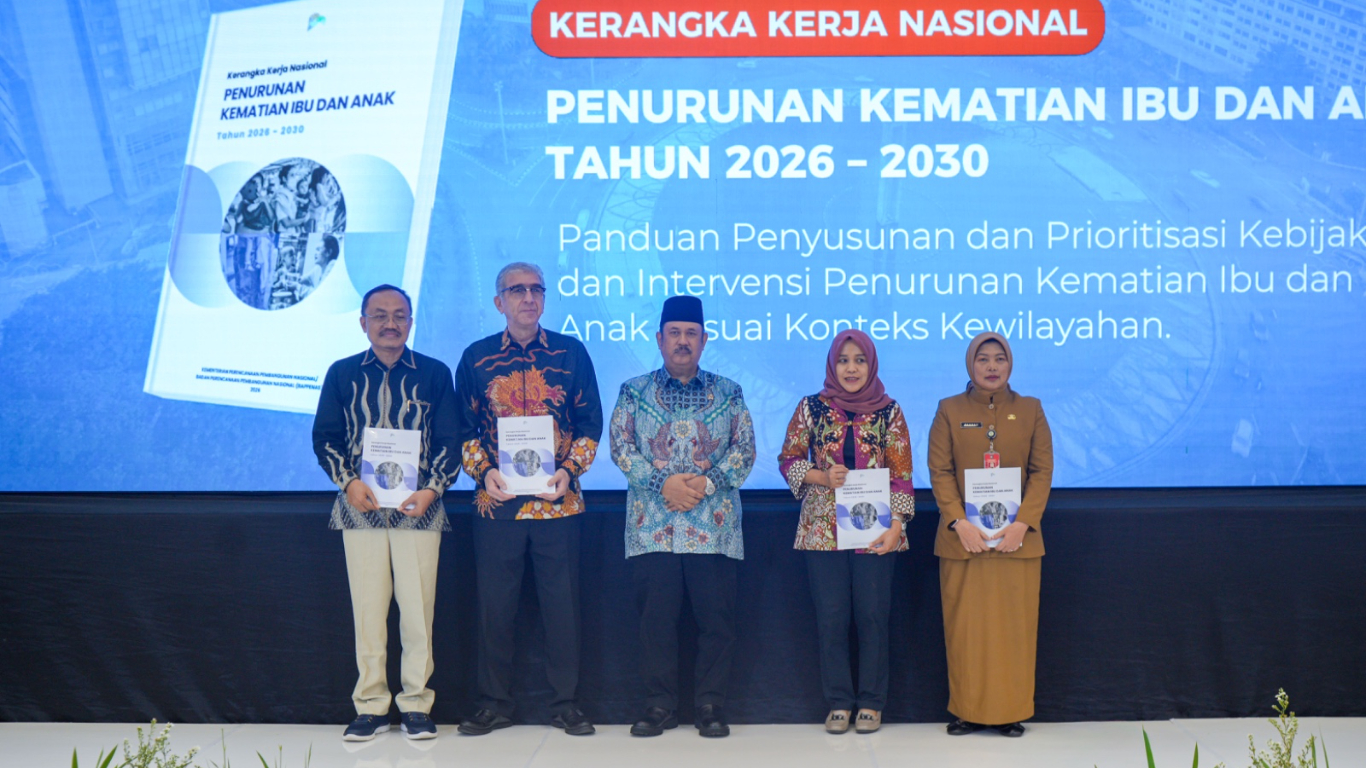
The Government of Indonesia has achieved 62% of the Sustainable Development Goals (SDGs). With only five years remaining to reach the 2030 deadline, we need to accelerate the achievement of sexual and reproductive health targets. For example, although the Maternal Mortality Ratio (MMR) has drastically declined from 346 per 100,000 live births (2010) to 189 (2020), it is still far from the National Medium-Term Development Plan (RPJMN) 2025-2029 and SDG targets of 77 and 70 per 100,000 live births, respectively. To maximize the demographic bonus peaking in 2030, investment in strengthening human resources and population resilience in the face of demographic shifts is highly necessary.
The United Nations Population Fund (UNFPA) has supported the Government of Indonesia in sexual and reproductive health, youth, population and development, and gender equality for over 50 years. Today, the Country Programme Implementation Plan (CPIP) of the 11th Cooperation Programme Cycle (CP11) between the Government of Indonesia and UNFPA for the 2026-2030 period was officially launched (21/04). This strategic cooperation is designed to support the "Golden Indonesia 2045" vision with a main focus on enhancing human resource competitiveness, primarily through the agenda of health development for all and strengthening gender equality.
The Minister for National Development Planning/Head of Bappenas, Rachmat Pambudy, stated that “Cooperation with UNFPA is very important. This cooperation program will support the implementation of various global instruments that are priorities for the Indonesian government, including SDGs, welfare, and gender equality.”
In his remarks, Minister Rachmat Pambudy further explained that the “Ministry of National Development Planning/Bappenas, as the government’s coordinating agency, will continue to ensure that this cooperation program is aligned with national priorities, while strengthening its implementation through the support of implementing and strategic partners”.
The CP11 program is directed towards achieving transformative results: ending preventable maternal deaths, ending unmet need for family planning, adapting to demographic changes, and eliminating gender-based violence and harmful practices against women and girls. This is in line with the RPJMN 2025-2029 and the SDGs 2030. With an estimated budget of US$ 38.5 million, the program will prioritize interventions in areas with high disparities and communities in vulnerable situations.
"The 11th cycle of cooperation between the Government of Indonesia and UNFPA marks the final transition from service provision and capacity development towards strengthening sustainable policies and systems," said Hassan Mohtashami, UNFPA Representative in Indonesia. "Our vision for 2026-2030 is to accelerate progress in strengthening institutional capacity, closing gaps, and changing adverse social norms so that Indonesia achieves national priorities and global commitments," he affirmed.
Hassan Mohtashami, UNFPA Representative in Indonesia, stated that “This cooperation program will focus on strengthening systems, improving service quality, and utilizing data to support more effective policymaking. We will continue to promote the elimination of harmful practices against women and children, while ensuring that sexual and reproductive health remains a key priority amid global challenges.”
Hassan added that “Through collaboration with the government and strategic partners, we aim to accelerate progress, strengthen institutional capacity, and drive sustainable change”.
The CPIP outlines programs aiming to achieve four main outputs, including: (1) strengthening capacity for the provision of quality sexual and reproductive health services, including improving the quality of midwifery education, emergency maternal and newborn care, and family planning; (2) strengthening planning, budgeting, and stakeholder partnerships for reducing maternal and infant mortality, and violence against women and girls (VAWG) prevention and response; (3) strengthening the production and utilization of population data for evidence-based policy formulation and development planning; and (4) increasing institutional capacity to prevent and respond to VAWG and harmful practices.
The CP11 partnership strategy will involve various stakeholders, including government institutions, the private sector, faith-based organizations, academia, and civil society organizations. In addition, Indonesia will continue to strengthen its global leadership role through the South-South and Triangular Cooperation (SSTC) platform in the fields of sexual and reproductive health, population, and gender equality