


Bappenas and PTPN I Encourage the Transformation of Downstream Processing for Leading Commodities
Partnership News - Tue, 12 May 2026
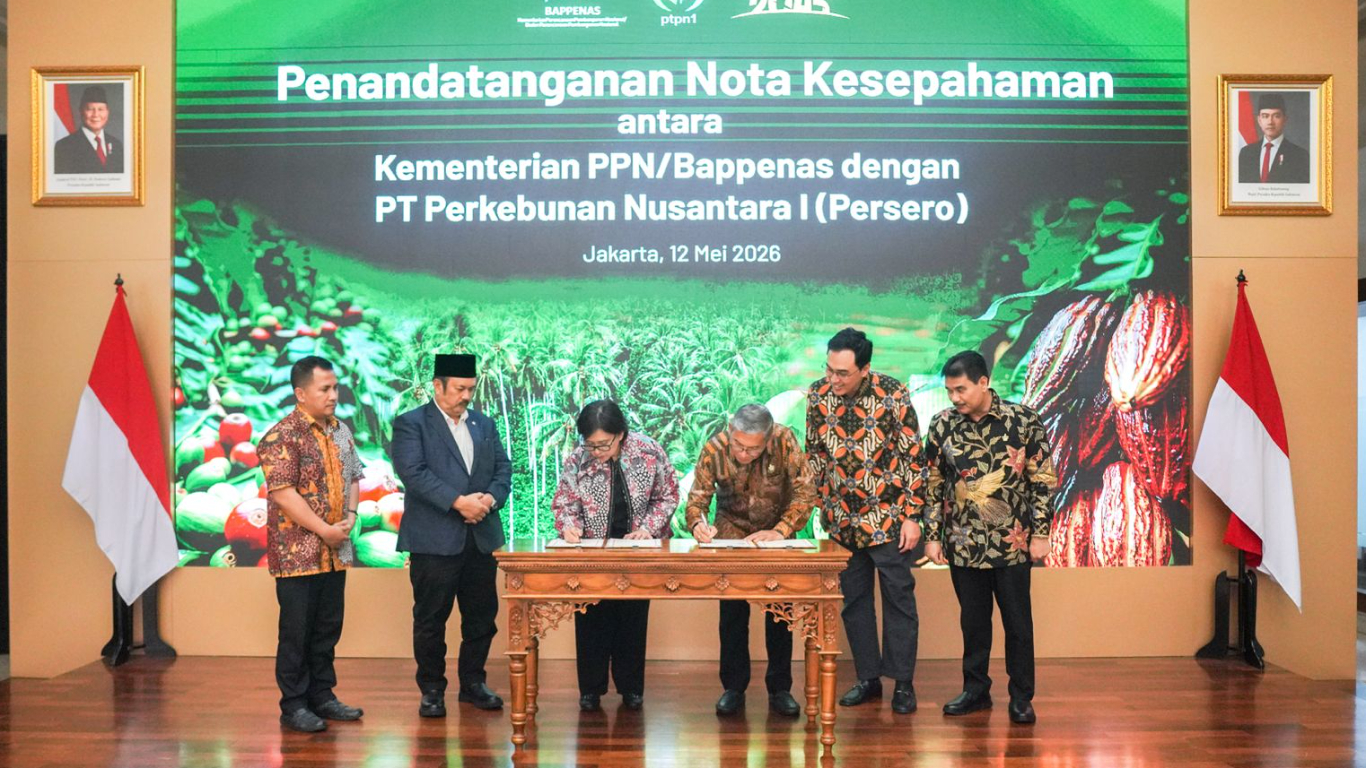
The Ministry of National Development Planning/Bappenas and PT Perkebunan Nusantara I (Persero) signed a Memorandum of Understanding as a strategic step to strengthen the planning and development of downstream plantation commodity industries through an integrated upstream-to-downstream approach.
The agreement was signed by Secretary of the Ministry of National Development Planning/Principal Secretary of Bappenas Teni Widuriyanti and President Director of PTPN I (Persero) Teddy Yunirman Danas, and witnessed by the Minister for National Development Planning/Head of Bappenas Rachmat Pambudy at the Bappenas Office in Jakarta on Tuesday, 12 May.
“I want this to become a historic milestone for us. Going forward, the agriculture, livestock, plantation, and fisheries sectors will become leading sectors supporting the President’s programme to achieve food, energy, and water self-sufficiency. The strategic position of PTPN I in the future will also be important in supporting sustainable natural resource-based downstream industrialisation,” Minister Rachmat stated.
Deputy for Food, Natural Resources, and Environment at the Ministry of National Development Planning/Bappenas Leonardo A. A. Teguh Sambodo explained that Indonesia’s economic transformation must be directed towards increasing the added value of national commodities through the involvement of various stakeholders, including state-owned enterprises. In this regard, PTPN I holds a strategic position as a driver of the production sector in increasing the volume and quality of high-value food commodities so that they can enter industrial supply chains and global markets.
Through the Memorandum of Understanding, both parties will focus on developing downstream ecosystems for coconut, coffee, and cocoa commodities by optimising PTPN I’s land assets spread across various regions of Indonesia. The cooperation is also aligned with the development direction outlined in the 2025–2045 National Long-Term Development Plan (RPJPN) and the 2025–2029 National Medium-Term Development Plan (RPJMN), which promote economic transformation through the downstream processing of leading commodities.
The national plantation sector continues to face several challenges, including stagnant productivity that could threaten national competitiveness and fragmented supply chains that contribute to high logistics costs and low added value at the farmer level. In addition, there remains a gap between research outcomes and field implementation, as reflected in the limited number of pilot projects and the suboptimal implementation of nucleus-plasma partnership mechanisms.
Strengthening this cooperation is expected to address these challenges through an integrated strategy encompassing three main pillars: productivity, investment, and industry. In closing the meeting, Minister Rachmat affirmed, “Through this Memorandum of Understanding, we are not only strengthening the national economy and the company, but also planting the seeds of inclusive prosperity.